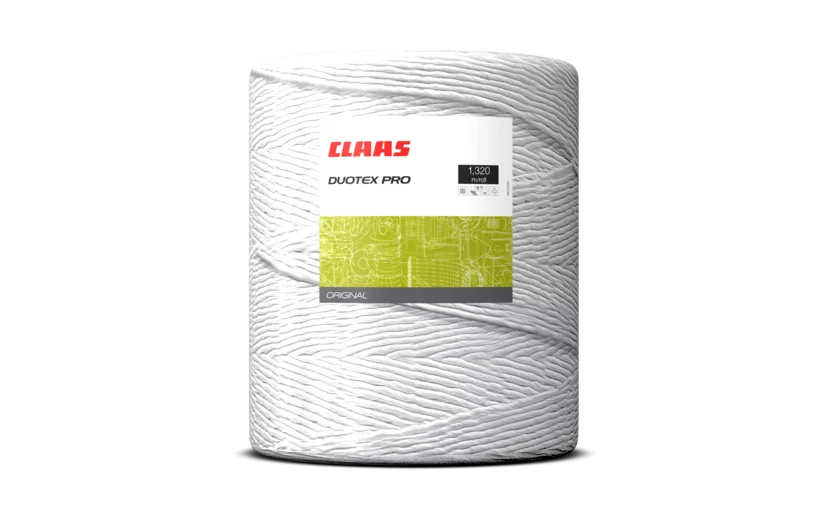



CLAAS Quadotex Twine

Length:
1,380 M1,170 M

CLAAS Quadotex twines have been developed for the latest generation of large square balers. The twine is built to match the balers potential for throughput and bale density. Delivering maximum knot strength and secure hold, Quadotex twine delivers long and productive hours of operation.

Features & Benefits

Guaranteed minimum length

Each spool contains the exact stated length.
Easy feed spool design Icon

Easy feed spool design

Ensures that the twine flows freely and evenly from the start of the spool to the very end.

High Strength

All CLAAS twines are highly fibrillated, guaranteeing that the twist is uniformly applied to the twine allowing trouble-free operation.

Knot Performance

Flexibility and strength for consistently secure knots on your bales

Efficient

Advanced twine materials mean less plastic needed per bale and less waste in the field

UV Stable

Excellent twine longevity even under extreme continuous exposure to sunlight
High Density Icon

High Density

Perfect For high density balers operating in extreme conditions

Length

More length for less spool changes, less waste, and higher efficiency.

Specifications

Product Name Weight Length Height Diameter Colour Selling Unit Units per Pallet
CLAAS Quadotex Twine
11.5 ± 3% KG
1,380 M
360 MM
300 MM
WHITE
Single Spool
80
CLAAS Quadotex Twine
11.5 ± 3% KG
1,170 M
360 MM
300 MM
LIGHT GREEN
Single Spool
80
Product Name
Weight
Length
Height
Diameter
Colour
Selling Unit
Units per Pallet
CLAAS Quadotex Twine
11.5 ± 3% KG
11.5 ± 3% KG
11.5 ± 3% KG
1,380 M
1,170 M
1,380 M
360 MM
360 MM
360 MM
300 MM
300 MM
300 MM
WHITE
LIGHT GREEN
WHITE
Single Spool
Single Spool
Single Spool
80
80
80

3 Products

prev slide next slide

Contact your local Tama representative

Choose your category and State
Crop baling Pallet wraps
Browse your contact man by State
Results (7)
Results (7)
Regional Sales Manager Ed Leggett
Ireland | Northern Ireland | Northern England | Central England | Wales | South England
A decade of Pallet Wrapping experience has made Ed perfect for...
Ed
Territory Sales Manager Alastair Thomson
Scotland
Alastair covers the entire Scottish region and parts of Northern England...
Alastair
Territory Sales Manager Andy Lanczak
Northern England
Andy looks after customers in the North East and provides field...
Andy
Business Development Manager Warren Tatton
IA | KS | KY | LA | ME | MA | MI | MN | MT | NJ | NY | ND | OH | VT | VA | WA
Spanning nearly 20 years in the Crop Baling business, Warren has...
Warren
Territory Sales Manager Martin Andrews
Wales | South England
With a rich background in agricultural retail, Martin from Gloucestershire is...
Martin
Business Development Manager Warren Tatton
Northern Ireland | Central England
Spanning nearly 20 years in the Crop Baling business, Warren has...
Warren
R&D Management CTO Reuven Hugi
As a global company that operates worldwide and in different climates,...
Reuven

More ways we can assist

Service Request Icon

Service Request

Knowledge Centre Icon

Knowledge Centre

Training Icon

Training

Field Experts Icon

Field Experts

Questions about Twine?

We’ve got the answers

Questions about

Twine Baling Tips
Large Square Baling
Very careful attention should be paid to the bale pressure, depending on the type and condition of the crop being baled. During periods of extended dry and hot weather, for instance, straw bales may be noticeably lighter than during normal conditions, with the baler set to the same bale pressure setting.
In these circumstances, a decrease in pressure setting will overcome this; or, alternatively, a move to the next heavier twine is recommended.
For baling good quality large square silage bales, it is important to follow a few simple guidelines:

Ensure the crop has wilted to a minimum of 40 – 50% dry matter (DM), which will produce well-formed bales as well as excellent fermentation.
Ensure the twine box tension is reduced as much as possible, as twine friction experienced between silage bales during baling is much greater than between straw bales.
Eliminate as much air as possible from the crop when baling, as it is essential that sufficient crop is packed into the top of the bale to avoid misshapen bales being formed, which may be difficult for an automatic bale-wrapper to handle properly. A reduction in forward speed will help to achieve this by increasing the number of wads per bale.
Skip to content